Greg Brick, Ph.D.
The following is some groundwater speculation based on the new data set provided by the Minnesota Spring Inventory (MSI).
As I mapped springs in a westward direction in the Minnesota River valley in 2018, I came to that newly recognized Mother Lode of western Minnesota springs, the Big Stone Moraine (the other, long-established “Mother Lode” being the Agassiz beachlines). State Highway 7 runs along the eastern shore of Big Stone Lake, 26 miles long, from Ortonville to Browns Valley, with South Dakota on the western shore. It’s hard to keep your eyes on the narrow, twisting road, however, because there are so many springs gushing from the sides of the Big Stone Moraine and you have to map every one of them, with few safe places to turn off.
At the town of Browns Valley, Glacial Lake Agassiz overtopped the Big Stone Moraine circa 12K calendar years ago, initiating Glacial River Warren, predecessor of the Minnesota River. I wanted to visit the exact point where the overtopping occurred. But upon exploring the sapping ravines along the flanks of the Big Stone Moraine, especially at Big Stone Wildlife Management Area near Ortonville, I began to see other possibilities. Sapping ravines are created by springs gnawing their way back into a hillside. Perhaps the initiation of Glacial River Warren was not so much an overtopping event as a sapping event? If one of the springs ate all the way through, the entire flow could be captured, perhaps in a catastrophic dam burst. Here, my early job experience installing piezometers along the Mississippi River floodwall in St. Louis, Missouri, for the U.S. Army Corps of Engineers, came to the fore.
So is that really what happened? I explained my sapping scenario to Dr. James Cotter at the University of Minnesota at Morris, who has studied the Big Stone Moraine in detail. In an email dated May 25, 2018, he replied that “earthen dams fail. I’m not sure if your model is the same as ‘piping induced failure’ but the difference in the chemistry of the till dam (the Cretaceous is just loaded with salt) and the lake water (meltwater from a glacier will have little in terms of dissolved solids) would have created a very dangerous chemical instability just ripe for piping, and on the down-flow side of the dam, spring sapping. So yes, the model is good.”
Ultimately it makes no difference whether the Big Stone Moraine was overtopped by lake water, or whether it was undermined by springs, the result would be the same, the initiation of Glacial River Warren.
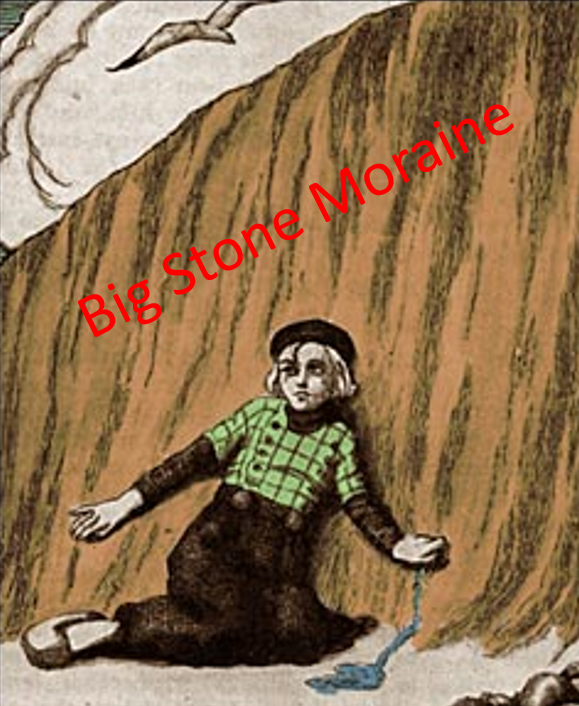
But it would elevate some obscure spring to a major role in changing the course of glacial history in Minnesota and introduce a “neo-catastrophist” event in our local glacial studies, though not on the same scale as the Missoula floods studied by J Harlen Bretz. Summoning the imagery of the Dutch boy who placed his finger in the leaking dike to stop it from bursting, I prepared the accompanying cartoon, which I used in my presentation on the progress of MSI mapping at DNR Region 4 Headquarters in New Ulm, 2018. Of course, this little hero was placed in a no-win situation!
 RSS - Posts
You must be logged in to post a comment.